
Searching the Blum Court Docket
The official Blum website offers no party-name or citation-number search. So begin with the paper record itself. A missing web result is not a missing case. The court name on the notice is your best routing clue. The issuing agency plus appearance instructions serve as checks. If your document is incomplete, call Blum City Hall. Ask which court or clerk receives that kind of citation.
- Read the citation or notice for the court name, issuing agency, citation or cause number, and appearance date.
- Check the official Blum site for current City Hall contact information; do not follow an unverified payment link.
- Call or email City Hall and ask for the responsible court and records custodian, giving identifying information without unnecessary private data.
- If City Hall directs the matter to a Hill County justice court, use the precinct contact it identifies.
- If the paper names a county or district court, use the Hill County channel for that level.
- Confirm the next date, delivery method, and any copy charge directly with the office that found the record.
Blum City Hall Is the Verified Fallback
City Hall sits at 105 S Ave C, Blum, Texas 76627. The phone is 254-874-5772 and the fax is 254-874-5702. Hours run Monday through Friday, 8 a.m. to 5 p.m. The office closes noon to 1 p.m. City Secretary Jackie Teel is listed on the official people page at jackieteel@cityofblum.org.
These details make a solid first contact, not proof of a municipal docket database. Ask one narrow question. Which court and clerk hold the citation tied to this number and issuing agency? Write down the office name, how you reached it, and the date of the answer. That record eases any later handoff. It also keeps payment or personal details from going to the wrong recipient.
The official Blum website shows the City Hall route described above.
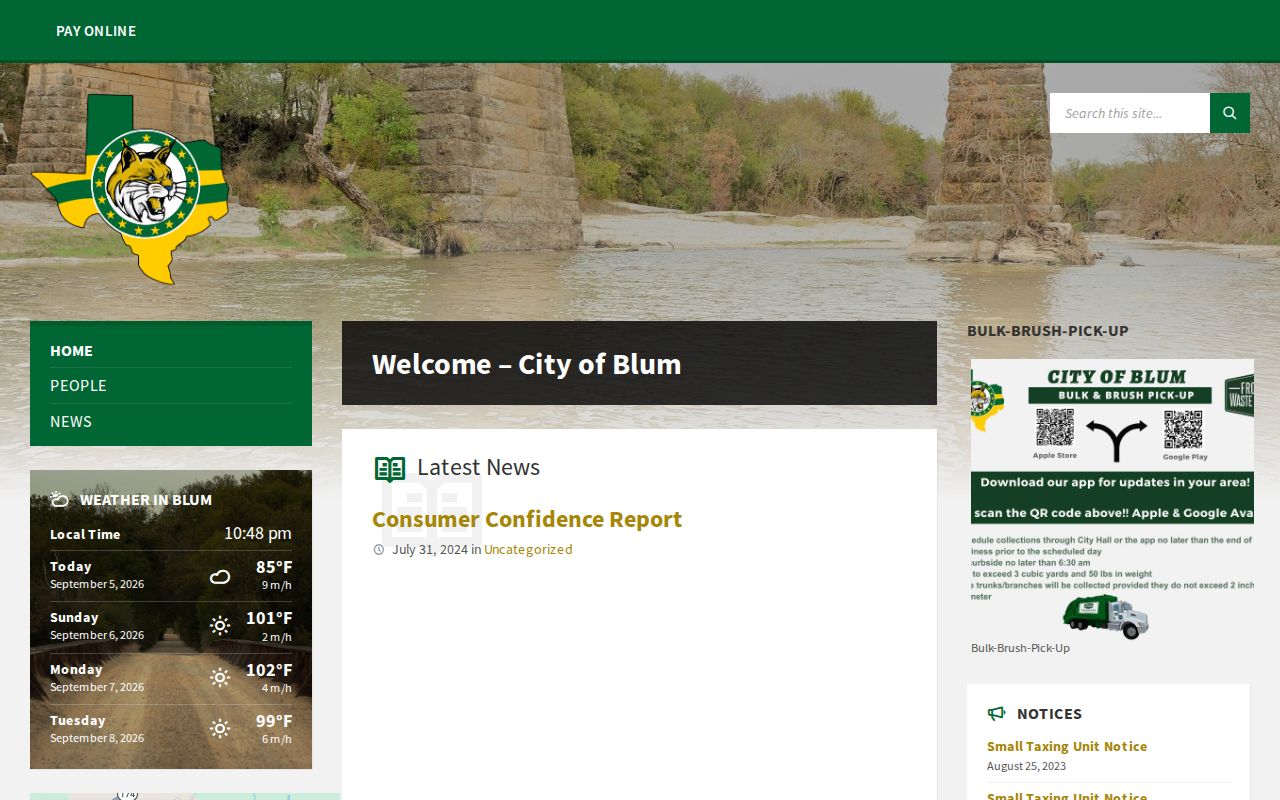
The captured city page confirms the local contact while the court-custodian question remains open.
Blum Municipal Court Basics
Blum publishes no municipal-court page. The city also does not appear in the Texas Office of Court Administration's municipal activity-by-city table. Neither gap proves Blum issues no municipal citations. It means the court name, docket custodian, search route, payment vendor, calendar practice, and copy procedure all need confirmation. None is a copy from another city.
That distinction drives any Blum docket search. Hillsboro, Whitney, Itasca, and Hubbard each have documented municipal-court sources. Their procedures do not transfer to Blum. A portal run by another municipality may not hold a Blum court record at all. The Hill District Clerk also states it does not keep traffic-ticket records. Mailing every local citation there is no safe default.
What to Have Before Calling Blum
A tidy set of clues lets City Hall or a court clerk find the docket without collecting more of your personal information than needed. Read straight from the current citation or notice. If the matter carries more than one number, label each exactly as the document labels it.
| Detail | Why it matters | What to verify |
|---|---|---|
| Court name | Identifies the likely custodian | Exact office and jurisdiction |
| Citation or cause number | Separates similar names | Which number the clerk searches |
| Issuing agency | Helps trace the filing route | Where the agency filed it |
| Appearance date | Flags a time-sensitive setting | Whether it remains current |
| Full name as printed | Supports a manual lookup | Spelling and suffix |
Never email a Social Security number, payment-card number, or unrelated identity document just to ask who holds a docket. Once you know the right court, follow its current secure instructions.
Court Dates and Settings in Blum
Blum posts no public daily calendar or municipal settings page. The date printed on a citation is only the initial lead. It is not proof the proceeding is unchanged. Ask whether that date is an appearance deadline, docket call, pretrial, compliance setting, or trial. Confirm whether attendance is in person. Get the exact location.
| Date | The current date confirmed by the court, not only an old copy or third-party listing. |
|---|---|
| Time | The appearance time and whether it is a general docket call or individual setting. |
| Location | The court's current address or authorized remote instructions. |
| Judge or court | The tribunal assigned, unverified until the custodian identifies it. |
| Setting type | Appearance, plea, pretrial, compliance hearing, bench trial, jury trial, or another event. |
If the court resets or cancels a Blum setting, ask how the change will be documented and get the new date. A call, email, copy request, or payment inquiry does not change an appearance obligation.
No Online Result Is Not an Answer
A blank result can mean several things. You may be searching the wrong court. The record may not be online. The spelling or number may differ. The filing may not have posted, or public access may be restricted. With no verified municipal search for Blum, that caution matters even more. Note where and when you searched, then go back to the citation and custodian chain.
Do not infer “no case.” Ask the official contact to confirm the responsible court and whether it offers public online lookup. A payment portal, if one is later identified, is not necessarily a complete docket database.
If an office says it does not hold the record, ask for the name and contact information of the next office. A documented handoff beats repeated searches of unrelated databases.
Traffic Tickets in Blum
The Hill District Clerk does not maintain traffic-ticket records. Trace a Blum citation to the court printed on it. That could be a city-level custodian, a Hill County justice court, or another named authority. Citations written in Blum do not all follow one route.
Before paying, requesting defensive driving, seeking deferred disposition, submitting compliance proof, or entering a plea, confirm the receiving court. Then confirm the deadline. Blum publishes no uniform ticket fees, eligibility rules, dismissal procedure, or official payment vendor. Do not reuse Hillsboro or Itasca forms. Never pay a company just because a web search pairs it with Blum.
The countywide Hill County traffic-ticket routing explains how municipal and justice-court custody differ. For any Blum matter, the citation controls.
Blum Compared With Published City Routes
Blum ranks fifth among the required city pages because the Hill County 2026 hazard-mitigation plan lists a 2020 Census population of 383. That number drove page selection only. It says nothing about case volume. The FY2024 OCA municipal activity table shows no confirmed row for Blum, unlike four larger listed cities.
| City source pattern | What research confirmed | Proper use for Blum |
|---|---|---|
| Hillsboro | Settings, forms, contact, payment link | Comparison only |
| Whitney | Municipal page and ticket-payment route | Do not assume shared custody |
| Itasca | Detailed payment and compliance channels | Do not borrow instructions |
| Hubbard | Official court page and directory entry | Not evidence of Blum procedure |
| Blum | City Hall and city-secretary contact | Ask for the custodian |
OCA fields are administrative totals, not counts of residents, guilt, or risk. Blum's missing row stays an open gap; it is not a zero.
Where Blum Cases Go
Where does a Blum case go? It may stay with the local or justice-level court named on the citation, or start at a higher Hill County level depending on type. Justice courts hear fine-only matters and certain civil disputes. County and district courts take the criminal, civil, family, and other cases assigned to them. Geography alone never tells you who keeps the docket.
Docket flow: Blum city or named justice-court route › Hill County Courts › 66th Judicial District Court
Treat this as a routing ladder. It is not a promise that every Blum case touches each tier. The filing court named on the paper is the one that matters. Suppose a Hill County matter is confirmed. Then the Hill County court docket overview lays out the local portal and clerk routes. None of them replaces the citation custody held by the court that actually issued the Blum paperwork.
City Secretary or Justice Court?
Start with the Blum city secretary whenever a citation's custodian is unclear. That office is the confirmed first stop. A justice court only becomes the right venue once the case is tied to that precinct. The tie can come from the citation itself, City Hall, the issuing agency, or an official directory. Hill County runs four justice offices. They sit in Whitney, Hillsboro, Malone, and Itasca. Don't pick one just because it sits closest to you.
- City secretary
- The official local contact who can help identify where a Blum matter is routed; not automatically the clerk for every citation.
- Justice court
- A precinct court with defined fine-only and lower civil jurisdiction.
- District Clerk
- The custodian for district-court records, not the general holder of traffic tickets.
- Issuing agency
- The body shown on a citation, which can help identify where it was filed.
If a case gets transferred, ask the receiving office to state its full court name in writing. Do that before you talk payment or mail off any request.
Reading a Blum Docket Entry
Once the right court finds the record, think of the docket as a timeline. It is a timeline in list form. A single entry might name a filing, an event, an order, a plea, or a setting. Some entries show nothing more than a date and a brief line of text. The document behind that line is often separate. Getting a copy can take its own request.
| Cause or citation number | The court identifier; copy punctuation exactly. |
|---|---|
| Case type or violation | The court category or allegation, not a final result. |
| Filed date | When an item entered the record. |
| Setting | The next event, subject to later orders or resets. |
| Status | An administrative state read with later entries. |
| Disposition | The recorded resolution, which may point to a judgment. |
A charge label or an open status on a Blum docket says nothing about how the case ended. When the exact result matters, ask the clerk for the filed order.
Blum Court Record Access Rules
Texas treats court case records under judicial access rules, so a Blum request is not the same as asking a city office for routine paperwork. Ask the clerk of the court that keeps the case record. Before you pay anything, find out what a plain, certified, or redacted copy costs, and whether you can inspect the record in person instead.
Key rules:
Texas Judicial Branch access guidance distinguishes court case records, Rule 12 judicial-administration records, and government records under the Texas Public Information Act.
Texas Family Code Chapter 58 restricts juvenile justice information.
Texas Code of Criminal Procedure Chapter 55A governs expunction.
Sealed, expunged, juvenile, and protected details may be missing or blacked out. A docket listing does not promise that every document is open to you. Where access is limited, ask the clerk which rule applies and what portion the public can still see.
Document the Blum Handoff
With the public court route still unsettled, a simple contact trail saves you from repeating the same dead ends. Write down the date and time. Note the office you called, the number or address you used, any limited identifiers you gave, the office named as the holder, and the next deadline. City Hall may send the citation back to the issuing agency first. If so, ask that agency which court the charge was filed in.
Check any oral instructions against a written notice or an official contact when you can. If an office hands you a vendor link, open it from the official government page, never a search ad. Keep your receipts and submission confirmations. That way the uncertainty stays honest. A Blum reader still has a workable route to the right docket.